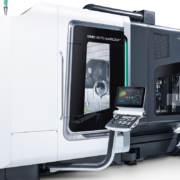
The first components have been produced on RIVAL’s new DMC 80 FD duoBLOCK CNC milling machine. The production process is optimised continuously and the capacity of the machine is in great demand.

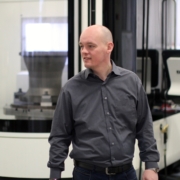
Initially, RIVAL’s 5-axis CNC milling machine has to produce approximately a thousand components to a big customer in the defence industry. “The processing centre works perfectly with components, to which the precision demands are high and there is relation between the turning and milling surfaces,” says production manager Søren Djursland.

Ongoing optimisation of processes
The components, which are processed right now, have a size of Ø700. The processing centre can handle components to the extent of Ø1000. “We have made a 100 % measurement of the first components processed on the Zeiss measurement in order to get the proper knowledge about the stability of the processes,” according to Søren.

Among the critical measurements of the components are a flatness of 0.05 mm and a drilled hole of Ø4 mm through two types of material over a length of 200 mm.

“We have delivered the first components to the customer, who approved them, and we have implemented good and stable production processes,” says Søren Djursland. “Still, we are continuously optimising the processes in order to secure the best productivity. In that connection, we have a close collaboration with our tool manufacturers, who are in possession of specialised knowledge, which makes the production processes even better.”

Twenty-four-hour operations require more “clever hands”
Initially, RIVAL has specially trained three employees in programming and handling the production on the new machine. “Today, we successfully operate by two-shift working and the plan is to implement three-shift working around the clock,” according to Søren Djursland. “We are constantly searching for new employees with “clever hands”, who are experienced in 5-axis milling, Siemens-operations and processing of big, complex components.”

Continuing development of the strategy
The DMC 80 FD duoBLOCK CNC machine is an important parameter in RIVAL’s production of critical and costly one-off components to the customers. This is an area, in which RIVAL has many competencies as a result of working in many industries, such as the oil & gas, the defence, the robot and the wind industry.

At the same time, the machine is part of the company’s new to-sided production strategy, in which RIVAL’s current business is expanded with night production of other components, than those typically produced during the day.

“With the new strategy, we offer our customers something new, which increases the value of collaborating with us,” says Søren Djursland. “Being the machining company of the future, we are very aware of continuous development and progression. We want to improve our current lines of businesses and we want to think innovatively. For this purpose, the two-sided production strategy is a good example.”

More news

If you want to be a subcontractor to important customers, it is a requirement that you are in control of processes and traceability, and that you deal with non-conformances. People know this at RIVAL, which is currently working on converting from ISO 9001:2008 to ISO 9001:2015.

RIVAL was first ISO certified in 2012, in accordance with ISO 9001:2008, and has since been re-certified with praise. In the spring of 2018, the company is converting its certification to ISO 9001:2015.

Important part of the strategy
“For our business here at the machined component developer and manufacturer of tomorrow, it is crucial that there is control of the entire quality area, including dealing with non-conformances, drawing versions, measuring of tolerances and many other areas ”says CEO Carsten Tønnes. “Several of our customers carry out ongoing audits at our premises to confirm that we meet the quality assurance requirements for their projects. These audits form a valuable basis for the future collaboration.”

Focus gives the customer certainty
Liv Vallø is the quality coordinator at RIVAL, and works on the ongoing optimisation of the management system and its integrity in relation to the management of processes and the documentation of this. “I see that our customers recognise the whole of our approach to the area, and it provides certainty in the daily collaboration,” says Liv. “The way we deal with non-conformances is of course a point of interest for our customers, and they value our tough follow-up, which means that we become better and smarter all of the time – and in the final analysis, minimise potential hassle for the customer and our quality costs.”

Prerequisite for collaboration
At RIVAL, they have developed strong quality conduct, which is valued by the company’s customers – but it is also a prerequisite for collaboration. “We know that it both increases productivity, quality and reduces any hassle for the customer,” says Carsten Tønnes. “We therefore constantly work to further develop our conduct in the area. This is done in close collaboration with both customers and employees, which is an important part of ensuring that the overall quality conduct is strengthened.”

More news

High Demands on Quality, Documentation and Delivery Ability

Many customers make high demands on RIVAL’s ability to manage critical and costly components. One of these customers is Munck Cranes, who started a working relationship with RIVAL last spring.

High demands
The manager from the Norwegian company Munck Cranes made high demands when they were in the market trying to find a sub-supplier, who could process wire drums to the company’s cranes. The demands were not only on quality, but also on delivery ability, documentation and price.

The wire drums are critical and costly components, for which reason no failures were allowed. Munck Cranes chose RIVAL’s, who obtained raw material in record time and processed 14 wire drums in different sizes to the Norwegian giant cranes. The collaboration went well. “We are very pleased with the effort and the result. There is no doubt that we will use RIVAL again,” says senior buyer Odd H. Olsen from Munck Cranes, who employs 185 men in Scandinavia.

A competitive price
Hiring a sub-supplier to produce the wire drums was a late decision. Munck Cranes’ own production was out of operation, for which reason the company put high demands on the sub-supplier’s ability to deliver on time.

“We chose RIVAL for the job, because we believed in the company’s ability to lift the job quality-wise and getting it delivered at the agreed time to a competitive price,” says Odd H. Olsen.

Despite the distance between Norway and Denmark, RIVAL was good at communicating and giving feedback on the job. “They were very accommodating and quick at reporting back to us. Also, they contacted us if they were in doubt about something,” Odd H. Olsen says.

Critical and costly components
Henrik Holvad remembers how the Norwegians emphasised the importance of RIVAL being able to manage critical and costly components. “Managing critical and costly components within short time spans is a parameter, which we will focus on even more in the future. Concerning this parameter, we can really make a difference in the market,” says Henrik Holvad.

The plant at RIVAL is busy, and the company has just invested in a new DMC 80 FD duoBLOCK® CNC machine for the advanced production of among other things, components for the defence industry.

The hole for the foundation has been dug, and the machine is on its way from Germany. DMC 80 FD is a 5-axle multi-machine, which can work on components up to Ø 1000 mm.

Something special
“At RIVAL, we are underway with something special. In the last few years, we’ve built up a machine plant which can do exceptional things,” says CEO Carsten Tønnes. “Therefore, we are now investing in this advanced CNC machine, which is only found in a few countries, and at the same time, we’re also looking for an extra set of skilled hands.”

Looking for an extra set of skilled hands
Customers often come to RIVAL when they have components that are not easy to manufacture. RIVAL has demonstrated over many years that it has the employees and machinery that can deal with the task, regardless of whether it is components for the defence, oil, gas, or wind power industry.

RIVAL is thus looking for another employee with “skilled hands”, who has experience with 5-axle milling, multi-machine operation, the Siemens control system and the machining of large, complex components. “We’re very interested in hearing from experienced machine operators, who want to join our company,” says Carsten Tønnes. “We have many exciting jobs in the order book and a strong social circle, which I’m sure, will attract many experienced machine operators.”

More news

For 30-year-old Lene, being hired as an adult apprentice at RIVAL is absolutely the right thing for her. She really thrives in production and is not bothered by male jargon, cuts on fingers or the smell of burned skin.

Lene Kruse Jensen started as an adult apprentice at RIVAL in August 2016. She is a qualified physiotherapist but the profession was never a good fit for her. “I’m more on the same wavelength as my colleagues here, where we call a spade a spade,” says Lene. “It’s not a problem for me being one of a few women in a man’s world, both here at RIVAL and when I’m at school.”

Instructive running-in with small milling
As an apprentice, you move around in several areas in production, but until now it’s the “small milling” with Fadal and YCM milling machines that Lene thinks is the most enjoyable work. “It’s really exciting to be part of the entire running-in process of a new component, and being allowed to nerd around with the program and to find the correct tool,” says Lene. “You get a good feeling when it just works – and a good learning process when things don’t work and the tool doesn’t operate as expected. Overall, it’s very instructive and challenging to be allowed to try something. I get competent guidance from my talented colleagues, whom I can learn a lot from.”

Attractive workplace
Lene believes that RIVAL is a very attractive workplace with friendly and pleasant colleagues. “At the start, they could be a little surprised when I followed their jargon and made funny remarks too,” says Lene, smiling. “I feel really comfortable here, and we get on well, both during working hours and outside working hours. We have a good time at the social events, like the Christmas party.”

Lene is sharp
As an adult apprentice, Lene’s training course is 13 months shorter compared to a traditional apprenticeship. “It’s not a problem for Lene, because she’s sharp and quick at learning things,” says Production Manager Søren Djursland. “She’s the first female apprentice we’ve had here, and she’s coping really well. She understands that she can say no and she can join in the jargon, and she is very interested in the profession and in becoming more skilled. That’s a very good starting point.”

Se flere nyheder

How long have you worked for RIVAL?
I’ve been here for 11 years. I trained at Hammel Maskinfabrik, where I worked for a year. The job involved a lot of forging, so in order to further my skills I applied to RIVAL, where I got the chance to work with CNC machines.

What has changed since you started?
When I started there were only 15 of us, so you can certainly say the number of employees has gone up. Self-managed teams have therefore been created with six or seven people in each team. That means we’re pretty much free to plan the work ourselves, and that we all have a lot of influence.

What’s it like to work for RIVAL?
There’s a lot of freedom and the work is exciting. Things run well, and the atmosphere is good. Not just amongst
ourselves – the members of the management team are good listeners and very approachable.

What are the best jobs?
Special jobs where we have to produce a part quickly. It’s challenging, and you feel you help to make a difference because you know that someone, somewhere, desperately needs the part you’re working on.

What are the effects of the expansion?
The new production facilities are more spacious – there’s not much room to work here in the old building. Now there’s more  space between the machines, which makes it far easier to handle the parts. New and larger machines will hopefully also mean that we can increase production even further.

Mød flere medarbejdere