It’s connected to all manner of costs when we fail at RIVAL and don’t comply with the quality requirements or delivery terms, which are agreed-upon with the customer. However, we are only humans and therefore, we can’t avoid making a mistake.

Quality and delivery time are always essential parts of the deal, when our customers enter into an agreement with us. We always go to great lengths to comply with the agreements, which are made with the customer.

“When we fail”
“We take pains to keep our end of the bargain, because we know the costs, when we fail,” owner and CEO Henrik Holvad says. “I intentionally say ‘when’ we fail, because we know that it can’t be avoided.”

Costly
It’s an expensive business, when we make mistakes. The components, we process, are often critical and costly to the customer. Most likely they are going to be used several hundred meters below the surface of the sea or maybe they are going to Afghanistan with the purpose to make sure our soldiers stay safe inside their new Piranha 5 personnel carriers. Our production is timed, and it doesn’t allow time for delays.

Det koster derfor kunden både økonomisk og på hans omdømme/troværdighed, hvis kunden ikke kan levere til tiden til sine kunder. Samtidig koster det også her på RIVAL, når tingene skal gøres om, og medarbejderne skal arbejde i weekender og aftener for at afhjælpe de fejl, som er begået.

Vi skal lære af fejl

”Vi gør naturligvis alt for at undgå fejl og har både dygtige og veluddannede medarbejdere, gennemarbejdede procedurer og en stærk kvalitetssikring, som minimerer risikoen,” siger Henrik Holvad. ”Når det så sker alligevel, fordi vi er mennesker og ikke robotter, sørger vi altid for at lære af det, som skete, så vi undgår den samme fejl flere gange. Det er vigtigt for både os og vores kunder.”

Læs mere om vores kvalitetsomkostninger og leveringsevne

Se flere nyheder

Just now, a four-man team from RIVAL has travelled the long journey to Cuba to install new equipment and train the Cuban employees in using it. Soon to be 10 years ago, RIVAL delivered the first moulds to the Cuban customer, and recently the Cubans decided to extend the assortment with bigger moulds.

Back in 2010, RIVAL produced and installed 28 moulds with the size of Ø200 – Ø1000 mm at Ciego Plast, which is located in the middle of Cuba and about 400 km from the capital Havana. The moulds are applied at the company’s extrusion line, and they are easy to replace with the pipe tool, when the production changes from pipes to flanges.

Moulds and CNC-machine
“This time around, the customer has bought two Ø1200 mm moulds from us as well as our CNC-machine,” RIVAL’s owner Henrik Holvad says. “The mould solution is ideal to the production of flanges and spacers. It provides a more effective utilisation of their production machinery to a much lower price than the alternative, which would be to make a big investment in an injection moulding machine with instruments.”

With the newly installed CNC-machine, the customer can complete the moulded flanges in-house. Previously, they had to send all the components off-site, which caused many delays and erratic quality.

A strong team
RIVAL’s very experienced and long-time group manager, Torben Pedersen, went to Cuba with Martin Højvang Pedersen and apprentice Kristian Bilstrup from RIVAL to install the CNC-machine in the customer’s production area. However, the Cubans only speak Spanish, which none of the three guys can brag about. Therefore, Kathrine Nielsen went with the three guys to act as interpreter.

Torben, Martin and Kristian all contributed with their different skills, and they supplemented each other well. Torben has produced many moulds, and he knows everything there is to know about them and the CNC-machine. Martin used to be a tractor mechanic, and he knows how to solve many tasks with only a few resources. “Give the man a bended nail and some cable ties, and he can do everything,” Torben says. “However, despite the fact that we tried to predict potential complications before we left, we were aware that we would enter situations, in which we needed something, we couldn’t get. In those situations, Martin’s skills were indispensable. Kristian is always full of energy, and he solves the jobs, we give him, quickly and efficiently.”


Indispensable interpreter
The 24-year-old student Kathrine joined the team and acted as interpreter. She speaks Spanish fluently as a result of having spent a year studying abroad in Chile. Torben told her, which technical terms, she needed to practice from home. Therefore, he introduced Kathrine to all the technical stuff at RIVAL, and she participated in the preliminary meetings with the Cubans during the sales process.

“Kathrine did an amazing job,” Torben says. “She successfully translated my explanations to the Cubans in Spanish as well as translating their questions to Danish.”

Education, installation and a goodbye to an old friend
Torben has spent many months in the moulds production, and he prepared the installation and education before he went to Cuba. At the same time, he had to prepare himself to saying good to the CNC-machine, he had “collaborated with” for many years at RIVAL.

“We have followed each other for many years, so it almost felt like saying goodbye to an old friend,” Torben says. “Therefore, it feels good that I went to Cuba to see its’ new home.”

A great experience
RIVAL’s 17-year-old apprentice Kristian had been looking forward to going to Cuba for many years. “Since the day Torben told me I was going to Cuba, I asked him every day, when we were going and if he was a hundred percent sure that I was going,” Kristian says.

“It was very cool to go to Cuba an experience how different their system is compared to ours,” Kristian says. “It doesn’t work well with my temper, because everything is going so slow and is not as effective compared to back home. However, it was very nice to experience the country, and I learned a lot from the many professional challenges, I had to solve. Also, we had a lot of fun in the group that went.”

We make a difference
The trip to Cuba was a great experience to the team, which has worked hard and for many hours, while they were gone, which the customer appreciated. “In this job, we could really make a difference to our customer due to our competencies, tools and machines,” Torben says. “The Cubans really wanted to learn from us, and they produce nice products despite the fact that their production is in no way comparable to ours. It was a big experience to see – yet it does feel good to be back in Denmark again.”

Se flere nyheder

Customer-specific blade profiles from RIVAL help generate valuable test data for Danish and thus the world’s leading wind turbine manufacturers as well as universities working on developing the wind turbines of the future.

Wind power is a major focus area in Denmark, and the government has made it a firm objective that sustainable energy must cover 100% of the Danish energy consumption by 2050. Danish wind turbine manufacturers are dominant in Europe and work hard to maintain this position in a market that has grown by more than 25% per year for the last 18 years.

Full-scale tests are becoming a challenge
As part of this development, the wind turbines are becoming bigger and bigger. This creates challenges when it comes to testing the blades for capacity and safety without having the facilities to do full-scale tests. The blades are considered one of the most critical parts of a wind turbine, and today the average blade is around 90 metres long. Blades of up to 107 metres are on their way. Design, materials and solutions are therefore often validated on smaller blades or using scaled tests.

The best approximation
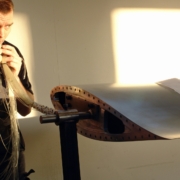
For several years, RIVAL has collaborated with leading wind turbine manufacturers and several universities to develop blade profiles (cross sections) that give the best possible approximation of full-scale blades as regards design, surface, material and execution. “Today we can offer our customers a tried and tested product that complies with the strict requirements to the blade profiles used in the tests,” says development engineer Esben Sarenbæk from RIVAL. “We produce many different blade profiles each year. The customers typically test one blade at a time, perhaps with 2–4 different profiles, and we deliver one a week during the test period.”

“Feinschmeckerei”
“We typically receive a 3D drawing from the customer, which we process in our CAD system, and there are a number of processing and assembly requirements that we have to comply with. A finished wind turbine blade, for example, has no joints, so neither do our blade profiles. During the final processing stage, all blade profiles are polished by hand so that even the slightest groove is completely removed. The blade model contains a number of 0.4 mm pressure holes that are connected to a pressure scanner by means of thin urethane hoses.”

In its work with blade profiles, RIVAL focuses on surface smoothness, homogeneity and contour in order to create the best flow around the blade profile and achieve the best approximation of the theoretical dimensions. This produces the best possible data for analysis by the customer.

Well-documented blade profiles
The blade profiles are also very well documented, and measurements are taken to check all the customer’s dimensions. Everything is documented in a report, which is attached to the individual profile. The profile is packed in a custom-made transport box which protects it both during transport and subsequent storage at the customer’s premises.

Close collaboration on development
Today, RIVAL collaborates with both Danish and foreign universities as well as wind turbine manufacturers about the further development of the blade profiles. “We have accumulated considerable competence in the area and often serve as a sounding board,” says Esben. “Recently we were contacted by a Dutch university which is in the process of developing a new model, and we have also manufactured a blade profile for the new wind tunnel at the Technical University of Denmark.”

More news

In mid-June, DNV GL completed an audit at RIVAL in connection with the company’s ISO recertification. After that, RIVAL received a lot of acclaim and is now certified in accordance with ISO 9001:2015 with no remarks.

The culture at RIVAL involves employee welfare and engagement as well as a well-structured management system, which is adjusting and improving continuously. “The recently completed audit confirmed just that,” says quality coordinator Liv Vallø from RIVAL and continues, “It was a great pleasure to accompany the auditor from DNV around our company and experience RIVAL through his viewpoint and to witness his excitement.”

Well-structured management system pays off
RIVAL’s owner Henrik Holvad confirms this positive experience. “On a daily basis, we focus on improving the internal procedures to the delight of both customers, employees and RIVAL. To remain a productive business, it is crucial that we are in control of our quality department. That involves management of deviations and customer claims, follow-ups on measurements and action plans, overviews of employee competencies and other areas in our management system, which need standard procedures.”

Acclaim and great engagement
RIVAL received a lot of acclaim by the completed audit. The auditor from DNV had 10 comments to RIVAL of which the nine were acclaim and the tenth was an improvement proposal, which the company has already implemented. “To achieve such a result is only possible due to the fact that we work as one big team every day,” says Liv. “It is amazing to experience the way all of our employees engage in the quality work and see the profit of it.”

Orderliness in everything
The core value of RIVAL – orderliness – was acclaimed in the completed audit too and RIVAL’s social responsibility for employing both apprentices and refugees was praiseworthy in particular. “At RIVAL, it is needless to say that orderliness is integrated in all parts of our business,” says Henrik Holvad. “We are very happy that our orderliness and many other ways of doing business are acclaimed in the completed audit. It is always nice to confirm that we do things well and appropriate. It has great value both in-house and in the collaboration with our customers.”

More news

Flemming Hansen has been the project manager at RIVAL for a good year. He is experienced in the business due to his former positions as machine worker and production engineer, which are valuable factors in the collaboration with the customers.

Flemming finds it very motivating to be involved in the customer’s project from the beginning to the end. He experiences having has a lot to offer in all phases of the project due to the knowledge, he has gained from his previous positions as machine worker, production engineer and constructor.

Close collaboration equals to the best starting point
“In the beginning of many of our projects, our sales director Christian Aarup and I discuss the customer’s needs and the technical possibilities to solve them already at the bidding,” says Flemming. “Thereafter, we might involve our foreman Glenn Scharling to get his opinion on the project. That results in the best starting point of giving the customer the best bid and ensuring RIVAL a reasonable economy on the project.”

Bigger projects and serial production
Right now, Flemming is the project manager of a big project to a customer in the defence industry, whose components RIVAL is responsible for assembling and installing after processing. “These types of projects are more and more frequent in our business, for which reason we are more experienced in helping the customer all the way throughout the project,” says Flemming. “At the same time, I am responsible for a number of projects, in which we serial-produce a large number of framework agreed components. In these types of projects, good communication is essential – both in-house and with the customer – to make sure that the project outcome is delivered in agreement with the terms.”

Wide experience provides daily benefits
Throughout the years, Flemming has had his hands far down in the engine room in the production as machine worker at several machining companies. The experience, he has built in the engine rooms is very valuable in the daily collaboration with both customers and colleagues in the production. “When we look at a new drawing of a component, which we have to design for a customer, I know pretty fast, which questions to ask. I share my knowledge with the customer’s engineers and we can solve potential confusions together very fast.”

Exciting development at RIVAL
Flemming appreciates RIVAL as his workplace. “At RIVAL we are very honest with each other, for which reason no one hold grudges, even though we do not agree on everything. It is very liberating and pleasant in the daily work,” says Flemming. “A lot has happened at RIVAL in the past year, we have started collaborating with new customers in new lines of businesses, we have implemented new machines in the production and we have carried out the new two-sided production strategy. It is very exciting to be a part of this development.”

More news

The first components have been produced on RIVAL’s new DMC 80 FD duoBLOCK CNC milling machine. The production process is optimised continuously and the capacity of the machine is in great demand.

Initially, RIVAL’s 5-axis CNC milling machine has to produce approximately a thousand components to a big customer in the defence industry. “The processing centre works perfectly with components, to which the precision demands are high and there is relation between the turning and milling surfaces,” says production manager Søren Djursland.

Ongoing optimisation of processes
The components, which are processed right now, have a size of Ø700. The processing centre can handle components to the extent of Ø1000. “We have made a 100 % measurement of the first components processed on the Zeiss measurement in order to get the proper knowledge about the stability of the processes,” according to Søren.

Among the critical measurements of the components are a flatness of 0.05 mm and a drilled hole of Ø4 mm through two types of material over a length of 200 mm.

“We have delivered the first components to the customer, who approved them, and we have implemented good and stable production processes,” says Søren Djursland. “Still, we are continuously optimising the processes in order to secure the best productivity. In that connection, we have a close collaboration with our tool manufacturers, who are in possession of specialised knowledge, which makes the production processes even better.”

Twenty-four-hour operations require more “clever hands”
Initially, RIVAL has specially trained three employees in programming and handling the production on the new machine. “Today, we successfully operate by two-shift working and the plan is to implement three-shift working around the clock,” according to Søren Djursland. “We are constantly searching for new employees with “clever hands”, who are experienced in 5-axis milling, Siemens-operations and processing of big, complex components.”

Continuing development of the strategy
The DMC 80 FD duoBLOCK CNC machine is an important parameter in RIVAL’s production of critical and costly one-off components to the customers. This is an area, in which RIVAL has many competencies as a result of working in many industries, such as the oil & gas, the defence, the robot and the wind industry.

At the same time, the machine is part of the company’s new to-sided production strategy, in which RIVAL’s current business is expanded with night production of other components, than those typically produced during the day.

“With the new strategy, we offer our customers something new, which increases the value of collaborating with us,” says Søren Djursland. “Being the machining company of the future, we are very aware of continuous development and progression. We want to improve our current lines of businesses and we want to think innovatively. For this purpose, the two-sided production strategy is a good example.”

More news